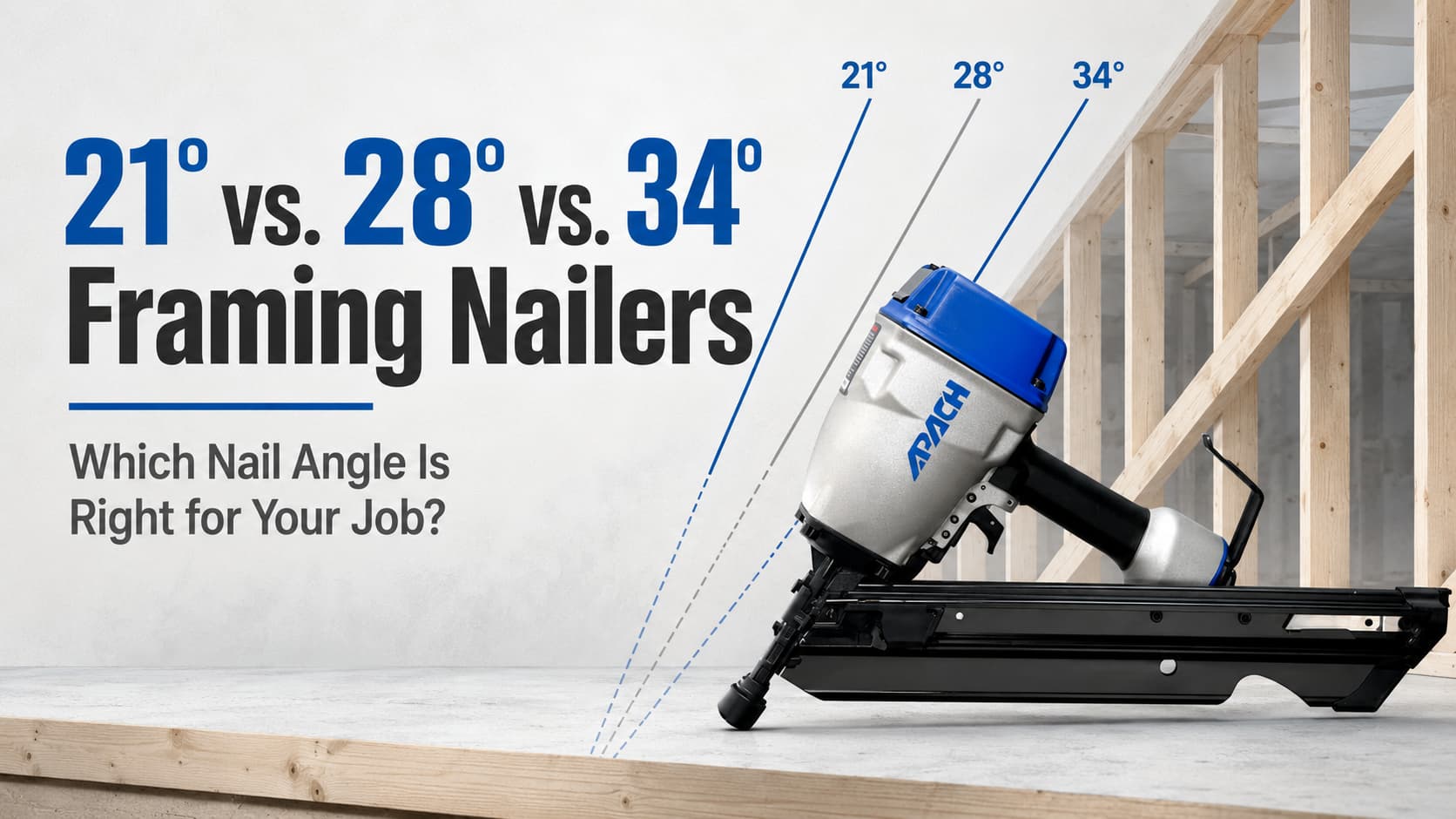
21° vs. 28° vs. 34° Framing Nailers: Which Nail Angle Is Right for Your Job?
For construction companies, prefabricated housing factories, pallet manufacturers, and wood packaging businesses, choosing the right framing nailer angle is mainly a question of fastener compatibility and working conditions.
The angle does not show how powerful the nailer is. It describes how the nails are arranged in the magazine and usually determines the collation type, nail head style, magazine shape, and compatible fasteners.
The quick answer is:
- Choose a 21° framing nailer when your operation uses full round head, plastic-collated nails.
- Choose a 28° framing nailer when wire-weld nails are already part of your fastening process.
- Choose a 34° framing nailer when you need a compact magazine for narrow working areas and use paper-tape nails.
Before making a decision, manufacturers should also check nail supply, material, production volume, working space, and local building requirements.
21° vs. 28° vs. 34° Framing Nailers at a Glance
| Nail Angle | Common Collation | Common Nail Head | Main Advantage | Suitable Situations |
|---|---|---|---|---|
| 21° | Plastic strip | Full round head | Familiar and widely used fastener system | General framing, prefabricated housing, pallets, and wood packaging |
| 28° | Wire weld | Depends on the fastener system | Narrower magazine with good nail capacity | Continuous production using wire-weld nails |
| 34° | Paper tape | D-head, clipped head, or offset round head | Compact magazine for limited spaces | Framing between studs, corners, and narrow assembly areas |
All three systems can perform framing and structural fastening work when the correct nail specification is used. The best option depends on the factory’s existing fasteners, workpieces, operating space, and production process.
Nail Angle Does Not Determine Holding Power
A common misunderstanding is that a higher nail angle provides greater holding power. In fact, a 34° nail is not automatically stronger than a 21° nail.
Holding power is affected mainly by:
- Nail length and diameter
- Smooth or ring shank
- Nail head design
- Penetration depth
- Wood type and thickness
- Nail coating
- Indoor or outdoor use
For example, ring-shank nails generally provide better resistance against being pulled out than smooth-shank nails of a similar size. Galvanized nails may also be required for outdoor products, treated lumber, or humid working conditions.
The nail angle should therefore be treated as a tool and fastener compatibility factor—not a measure of fastening strength.
When Is a 21° Framing Nailer the Better Choice?
A 21° framing nailer usually uses full round head nails held together by plastic strips. It is a practical choice for companies that need a flexible fastening tool for general production and construction work.
Common B2B applications include:
- Wall and floor framing
- Roof decking
- Prefabricated housing
- Door and window components
- Wood pallet production
- Crate and packaging assembly
- General carpentry
One of its main advantages is the use of full round head nails. This nail design may be preferred or required for certain structural applications.
The magazine is generally wider than a 34° magazine. However, this is usually not a major limitation on open production lines or in pallet and crate assembly, where the tool does not need to enter narrow spaces.
Plastic pieces may be released during firing, so proper eye protection and safe operating procedures are still necessary.
A 21° framing nailer is a good choice when:
- Full round head nails are required.
- Plastic-collated nails are easy to purchase.
- The work area provides enough tool clearance.
- One tool is needed for several wood fastening applications.
When Does a 28° Framing Nailer Fit the Process?
A 28° framing nailer commonly uses wire-weld collated nails. Because the nails can be arranged more closely, the tool can have a narrower magazine and carry a useful number of fasteners.
This can benefit factories with continuous fastening tasks because operators may spend less time moving the tool through restricted areas or reloading the magazine.
However, nail head designs and compatible fastener sizes can vary between 28° systems. Manufacturers should confirm the exact nail specifications before adding a tool to an existing production line.
Wire pieces may also separate during firing. Operators should wear eye protection, and nearby workers should remain clear of the discharge area.
A 28° framing nailer is worth considering when:
- The factory already purchases 28° wire-weld nails.
- A narrower magazine is useful.
- Fastener capacity is important for repeated work.
- The available nail head style meets the application requirements.
If wire-weld nails are not commonly available in the region, another nail angle may be easier to support over the long term.
When Is a 34° Framing Nailer More Practical?
A 34° framing nailer uses nails arranged at a steeper angle. This allows the magazine to be more compact, making the tool easier to position between studs, near corners, and inside narrow wood structures.
This design can be useful for:
- Prefabricated wall and roof sections
- Wood frame assembly
- Modular building production
- Work between closely spaced components
- Areas with limited tool clearance
- On-site framing and carpentry
A 34° system commonly uses paper-tape collated nails. Paper tape creates less hard plastic or wire debris around the work area, but it must be kept dry. Water or high humidity can damage the strips and lead to poor feeding.
A 34° framing nailer is a good choice when:
- The operator frequently works in narrow spaces.
- A compact magazine improves tool access.
- Paper-tape nails are readily available.
- The factory can store fasteners in a dry environment.
- The accepted nail head meets project requirements.
Match the Framing Nailer to Your Production Conditions
Nail angle is only one part of the decision. B2B users should review the complete production process before selecting a framing nailer.
1. Material and Application
Confirm the type and thickness of the wood, the required joint strength, and whether the finished product will be used indoors or outdoors.
A pallet factory, prefabricated housing plant, and on-site construction team may all use framing nailers, but their nail specifications and working conditions can be different.
2. Compatible Nail Range
Check the accepted:
- Nail angle
- Nail length
- Nail diameter
- Nail head
- Shank type
- Collation material
Do not assume that nails with a similar appearance will fit the same tool.
3. Working Space
For open workbenches, pallets, or large wood panels, magazine width may not be a major concern.
For framing between studs or assembling narrow structures, a compact 34° magazine may provide easier access.
4. Daily Production Volume
High-volume production requires more than driving power. Tool balance, weight, loading speed, nail capacity, trigger type, and maintenance access can affect operator fatigue and production time.
5. Fastener Supply
Choose a system with a reliable local supply of compatible nails. Using an uncommon nail angle can create purchasing delays and production interruptions.
6. Safety and Local Requirements
Confirm whether the project requires a specific nail head, nail coating, or fastening method. Building and structural requirements may vary between markets and applications.
APACH 21° and 34° Framing Nailer Options
APACH INDUSTRIAL CO., LTD. offers a range of pneumatic framing nailers for professional construction and industrial wood fastening applications.
The L2190 21 Degree Strip Framing Nailer uses 21° full-head plastic-collated strip nails. Its features include depth-of-drive adjustment, toe-nailing teeth, a dry-fire lock, a no-mar rubber pad, and a 360° adjustable air deflector.
It can support applications such as framing, roofing, carpentry, prefabricated housing, building components, crates, and pallets.
The L3490 34 Degree Strip Framing Nailer uses 34° D-head paper-tape collated strip nails. Its compact magazine arrangement makes it a practical option when tool access is limited.
Both models are designed for professional fastening work. The main difference is the fastener system and the working space in which the tool will be used.
Which Framing Nailer Angle Should Your Business Choose?
Choose a 21° framing nailer if your company uses full round head plastic-collated nails and needs a flexible tool for framing, pallets, crates, or prefabricated wood components.
Choose a 28° framing nailer if wire-weld nails are already available and compatible with your production process.
Choose a 34° framing nailer if operators need better access between studs, near corners, or inside narrow wood structures.
There is no single nail angle that is best for every business. The correct choice should match the fasteners, materials, production volume, working space, and local requirements.
Need help selecting the right framing nailer?
When contacting APACH, provide the application, wood material, nail dimensions, nail head, collation type, daily usage, and working conditions. This information will help identify a framing nailer that fits your actual production needs.