
15-Gauge vs. 16-Gauge Finish Nailers: Which One Fits Your Production Line?
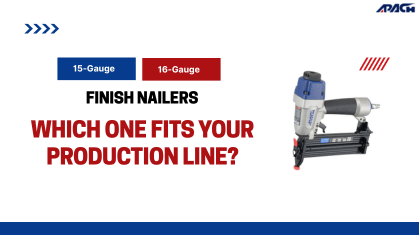
We break down the technical differences in holding power, hole size, and maneuverability to help manufacturers select the right tool.
In the industrial woodworking and trim sectors, the "Finish Nailer" is the workhorse of the assembly line. However, for procurement managers and production supervisors, making the right choice between the two dominant standards—15-Gauge (15Ga) and 16-Gauge (16Ga)—is often a point of confusion.
While they look similar on paper, these two tools serve distinct roles in a production environment. Choosing the wrong gauge can lead to weak structural joints (if too light) or unnecessary surface damage (if too heavy). This guide analyzes the technical differences to help you optimize your tool selection.
Two Standards, Two Purposes
15-Gauge (DA/FN)
The Structural Heavyweight
Associated with "Angled Finish Nailers", this tool shoots a thicker nail (approx 1.8mm) designed for holding power.
- Angled Magazine: Allows access into tight corners (like crown molding) where straight mags can't fit.
- High Holding Power: Massive shear strength holds heavy materials firmly without excessive glue.
- Best For: Heavy doors, stair treads, thick baseboards, and hardwood flooring rows.
16-Gauge (Straight)
The Versatile Standard
Associated with "Straight Finish Nailers", this is the "Goldilocks" tool—just right for most trim tasks.
- Smaller Hole Size: The thinner shank (approx 1.6mm) leaves a smaller entry hole, meaning less putty and sanding.
- Reduced Splitting: Gentler impact preserves delicate trim pieces and MDF that might split with a 15Ga nail.
- Best For: Cabinet assembly, window casings, paneling, and lighter trim work.
Head-to-Head Technical Comparison
| Feature | 15-Gauge (Angled) | 16-Gauge (Straight) |
|---|---|---|
| Nail Thickness | Thicker (High Holding Power) | Thinner (Medium Holding Power) |
| Hole Size | Larger (More putty required) | Smaller (Less finishing work) |
| Maneuverability | Excellent (Reaches tight corners) | Standard (Good for flat runs) |
| Risk of Splitting | Higher on thin wood | Lower |
| Primary Use | Structural trim, Doors, Stairs | Cabinetry, Fine Trim, Molding |
Which One Should You Deploy?
The decision ultimately comes down to your primary material and the specific stage of your production line.
Choose the 15-Gauge (Angled) if: Your production line handles heavy hardwoods, installs pre-hung doors, or assembles large furniture pieces that bear weight. If your operators frequently struggle to reach into corners with straight tools, upgrading to an Apach Angled 15Ga Nailer is a productivity booster.
Choose the 16-Gauge (Straight) if: You manufacture cabinetry, smaller furniture, or use delicate moldings. If "surface finish quality" is your top KPI and you want to minimize the labor cost of puttying nail holes, the 16Ga is the superior choice.
The Apach Advantage
At Apach, we understand that "one size does not fit all." That’s why we engineer durable, industrial-grade pneumatic solutions for both standards. Whether you need the heavy-holding power of a 15-gauge or the refined finish of a 16-gauge, Apach provides the reliability your production line demands.