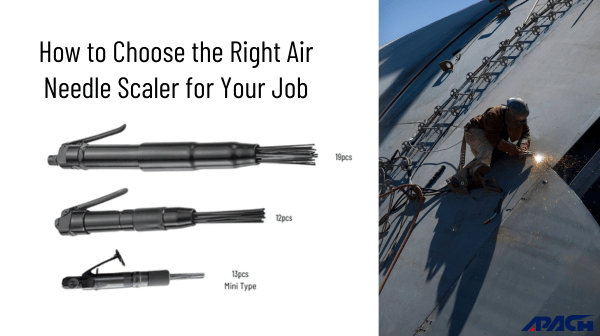
How to Choose the Right Air Needle Scaler for Your Job
If you're working in metal maintenance, shipbuilding, automotive restoration, or industrial surface preparation, chances are you've encountered rust, paint, or debris that just won't come off easily. That's where the Air Needle Scaler comes in — a powerful pneumatic tool that uses multiple steel needles to remove stubborn surface materials without damaging the underlying substrate.
But with different job types and environments, how do you choose the right air needle scaler? In this article, we’ll guide you through its functions, key considerations for selection, and most importantly, the industries and jobs where it makes the biggest impact.
What is an Air Needle Scaler?
An air needle scaler is a pneumatic tool designed to remove:
- Rust and oxidation
- Paint and coatings
- Weld slag and spatter
- Industrial grime and residues
It works by delivering rapid, hammering movements through a set of steel needles, powered by compressed air. The vibration breaks up surface contaminants while being gentle on the base material — making it ideal for surfaces that need cleaning but not grinding.
Get to know how air needle scalers work.
Who Needs an Air Needle Scaler?
Here's a list of common industries and jobs that frequently benefit from using air needle scalers. If you're in one of these fields, this tool could greatly improve your workflow:
| Industry/Job Role | Application |
|---|---|
| Shipbuilding & Marine Repair | Removing rust and marine scale from hulls, decks, and ship structures |
| Automotive Repair & Restoration | Stripping rust and paint from frames, chassis, and exhausts |
| Welders & Metal Fabricators | Cleaning weld seams, slag removal, surface prep before repainting |
| Construction & Civil Engineering | Concrete cleaning, surface roughening, rebar exposure |
| Industrial Equipment Maintenance | Removing hardened grease, oil buildup, or rust from machines |
| Bridge & Steel Structure Maintenance | Surface prep before repainting or inspection |
| Petrochemical & Refinery Workers | Safe cleaning of corroded pipes, tanks, or valves |
| Railway Technicians | Removing rust or scale on train undercarriages or tracks |
| Military Vehicle Maintenance | Restoring armored surfaces and equipment exposed to harsh conditions |
| Heavy Machinery Operators | Cleaning construction equipment between projects |
See more information of rust removel applications.
How to Choose the Right Air Needle Scaler
Here are five important factors to consider when selecting the best needle scaler for your job:
1. Needle Count
- Most models feature 12 to 19 needles.
- More needles = faster coverage, especially on flat surfaces.
- Fewer needles may be better for precise or small-area work.
2. Needle Material
- Standard hardened steel: Best for general rust and paint removal.
- Stainless steel or brass: Suitable for softer metals or explosive/hazard-sensitive environments.
3. Stroke Speed
- Higher blows per minute (BPM) means more aggressive and efficient material removal.
- Look for tools around 3,500–4,500 BPM for industrial-grade use.
4. Adjustable Power / Pressure Compatibility
- Some models allow adjustment of needle impact for different materials.
- Make sure the tool is compatible with your air compressor (most require ~90 PSI).
5. Ergonomic Design
- If you're using the scaler for long hours, weight, grip, and vibration damping matter.
- Choose a tool that's balanced, not too heavy, and comfortable to hold.
Know how to choose the right air needle scaler for automotive restoration.
________________________________________
Bonus: Maintenance Tips for Longevity
Like all pneumatic tools, air needle scalers require basic upkeep:
- Oil before and after use to protect internal seals.
- Clean needles after each session to avoid buildup.
- Replace bent or worn needles to maintain performance.
- Check for air leaks periodically.
Proper maintenance means longer tool life and consistent output.
Learn how to maintain needle scalers properly.
________________________________________
FAQs
1. What needle count is best for an air needle scaler?
The ideal needle count depends on your application. Models with 12–19 needles are most common. More needles provide faster surface coverage for large flat areas, while fewer needles offer better precision for tight spaces and detailed automotive restoration work.
2. Which needle material should I choose for rust and paint removal?
Hardened steel needles are the standard choice for heavy-duty rust, paint, and corrosion removal. Stainless steel or brass needles are better for softer metals, delicate surfaces, or environments where spark resistance is important.
3. What BPM (blows per minute) is recommended for industrial use?
For industrial-grade performance, look for an air needle scaler with around 3,000–4,500 BPM. Higher BPM delivers more aggressive cleaning and faster material removal, making it ideal for heavy surface preparation.
4. What air pressure does an air needle scaler require?
Most pneumatic needle scalers operate at approximately 90 PSI. Before purchasing, confirm that your air compressor can supply the required pressure and airflow to ensure consistent performance and proper tool operation.
5. How can I extend the lifespan of my air needle scaler?
Regular maintenance is essential for long-term durability. Oil the tool before and after use, clean the needles after each session, replace worn or bent needles, and inspect for air leaks periodically. Proper maintenance helps maintain consistent performance and prolongs tool life.
Conclusion: Is an Air Needle Scaler Right for Your Job?
If you work in metal restoration, industrial maintenance, ship repair, automotive bodywork, welding, or construction, an air needle scaler is a tool that can save you hours of manual labor while delivering precise, professional results.
At Apach, we offer reliable and durable pneumatic needle scalers built for tough environments and everyday use. Whether you're preparing a weld, restoring a ship, or cleaning heavy equipment, we have the right solution for your job.
Contact us today to learn more about our needle scaler models and how they can fit into your workflow.