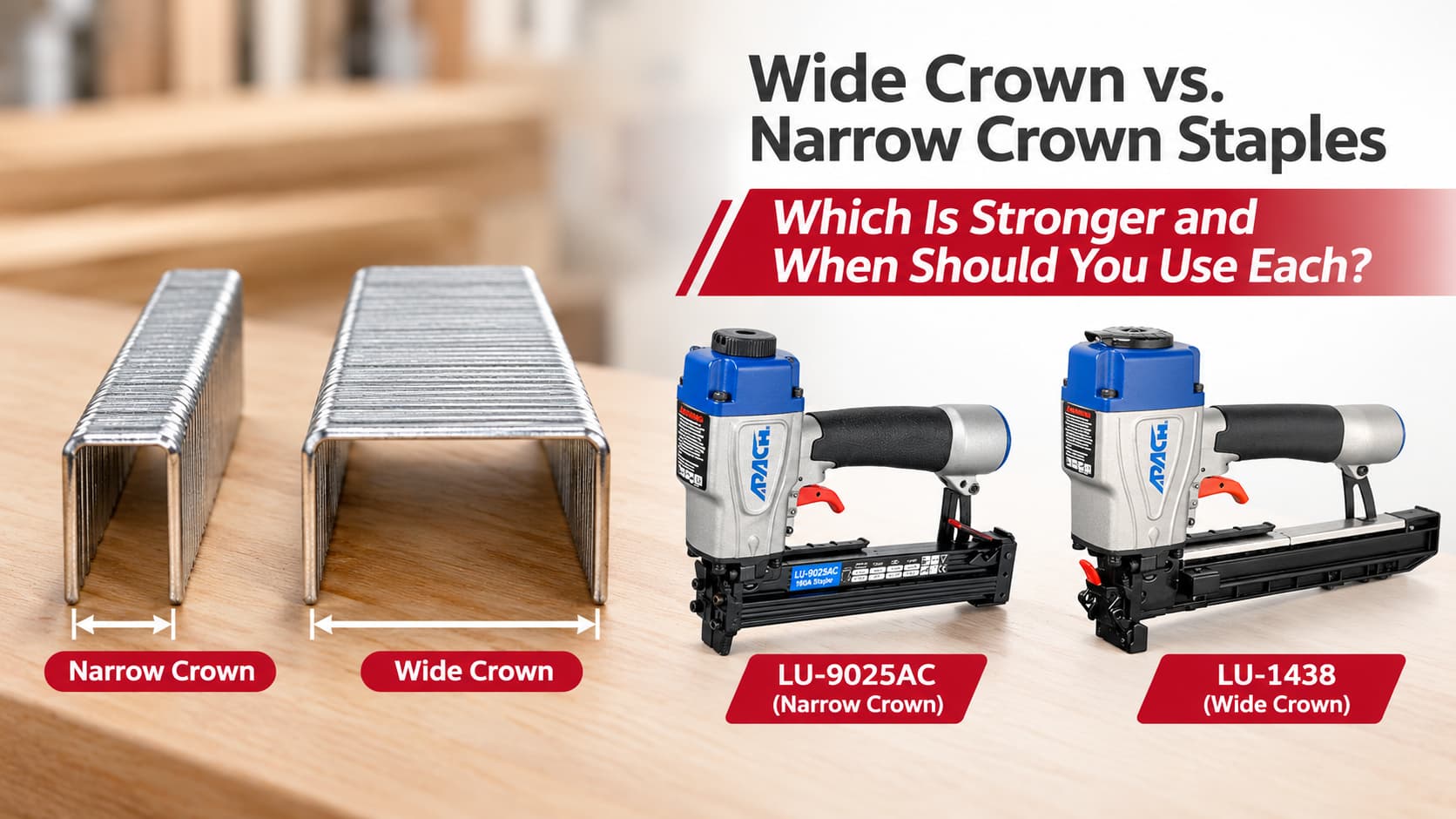
Choosing between wide crown and narrow crown staples is not simply a matter of selecting the stronger fastener. For furniture manufacturers, woodworking businesses, construction professionals, and industrial buyers, the right choice depends on material properties, fastening requirements, staple dimensions, and pneumatic stapler compatibility.
Wide crown staples provide a larger contact area that helps distribute pressure across the fastened surface, while narrow crown staples are often preferred for precise fastening and less visible staple marks. However, wider crowns do not automatically provide greater holding strength.
In this guide, APACH explains the differences between wide crown and narrow crown staples, compares their industrial applications, and introduces two pneumatic stapler models to help buyers make informed purchasing decisions.
1. Wide Crown vs. Narrow Crown Staples: Key Differences
The crown is the horizontal section connecting the two staple legs. Crown width determines how much of the fastened material is contacted by the top of the staple.
Narrow crown staples have a smaller contact area, making them suitable for applications where fastening precision and appearance are important.
Wide crown staples provide a broader contact area and are often selected for applications involving building components, construction materials, and industrial assembly.
Wide Crown vs. Narrow Crown Staples Comparison
| Feature | Narrow Crown Staples | Wide Crown Staples |
|---|---|---|
| Crown width | Smaller | Larger |
| Surface contact | More concentrated | More widely distributed |
| Fastening appearance | Less noticeable | More visible |
| Common applications | Cabinets, furniture, light wood assembly | Building components, construction, industrial assembly |
| Material considerations | Placement accuracy and penetration | Surface contact and joint requirements |
| Holding strength | Depends on complete fastener design | Depends on complete fastener design |
| Pneumatic stapler | Compatible narrow crown model | Compatible wide crown model |
For example, APACH offers the LU-9025AC narrow crown stapler with a 5.8 mm crown width and the LU-1438 wide crown stapler with a 24.8 mm crown width.
These models illustrate how crown width, wire dimensions, and fastening requirements vary between pneumatic stapler systems.
2. Which Staple Is Stronger? Understanding Holding Strength
Neither wide crown nor narrow crown staples are universally stronger. Fastening performance depends on how the connection is loaded and how the staple interacts with the materials being joined.
Three factors are particularly important when evaluating staple strength.
Withdrawal Resistance
Withdrawal resistance is the force required to pull staple legs out of the base material.
It is influenced by staple penetration depth, wire geometry, material density, and installation conditions.
A wide crown does not necessarily improve withdrawal resistance because much of the resistance comes from the interaction between the staple legs and the base material.
Shear Resistance
Shear resistance describes the ability of a fastening connection to withstand forces acting parallel to the joined surfaces.
Wire cross-section, staple orientation, joint design, and the number of fasteners can all influence performance.
A heavier-wire staple may provide greater resistance to deformation under certain conditions, but this must be verified through appropriate fastening tests.
Surface Load Distribution
Wide crown staples distribute contact pressure across a larger surface area.
This can be beneficial when the crown must retain a material against a substrate without concentrating excessive pressure at one point.
However, a broader crown does not guarantee better performance for every material, particularly when staple penetration or joint geometry is inadequate.
What Matters More Than Crown Width?
| Factor | Influence on Fastening Performance |
|---|---|
| Wire dimensions | Affect resistance to bending and deformation |
| Staple leg length | Determines potential penetration depth |
| Material density | Influences penetration and withdrawal resistance |
| Crown width | Affects surface contact and load distribution |
| Driving depth | Influences seating quality and material damage |
| Joint design | Determines how loads are transferred through fasteners |
For load-bearing or safety-critical applications, fastening performance should be confirmed through appropriate engineering evaluation and testing.
3. Which Crown Width Is Best for Your Application?
Different manufacturing environments require different fastening characteristics. The following table provides a practical starting point for staple selection.
| Application | Recommended Starting Point | Main Consideration |
|---|---|---|
| Cabinet manufacturing | Narrow crown | Precise placement and fastening appearance |
| Furniture assembly | Narrow crown or application-specific staples | Material thickness and joint design |
| Light wood assembly | Narrow crown | Penetration and fastening consistency |
| Door and window components | Wide crown or application-specific staples | Joint strength and component design |
| Building components | Wide crown | Surface contact and fastening requirements |
| Crating and pallets | Application-dependent | Material density and required holding performance |
| Roofing and carpentry | Application-specific wide crown staples | Substrate, load requirements, and installation standards |
Furniture and Cabinet Manufacturing
For furniture and cabinet production, narrow crown staples are often a practical choice because their smaller crowns are less noticeable on finished surfaces.
They can also support accurate fastening placement in relatively narrow components.
However, buyers should verify staple length and material penetration before selecting a pneumatic stapler.
Recommended APACH Model: LU-9025AC 18 GA Narrow Crown Stapler.
Construction and Building Components
Wide crown staples are commonly used in certain construction and building component applications.
Their larger crown contact area can be useful where the fastener must retain material across a broader surface.
The appropriate staple system depends on the material, required fastening performance, and installation requirements.
Recommended APACH Model: LU-1438 14 GA Wide Crown Stapler.
Industrial Packaging and Wood Assembly
Packaging and wood assembly applications can involve different material thicknesses and fastening requirements.
Both narrow crown and wide crown staples may be used in certain crating or pallet-related operations, depending on the specific joint.
For carton closing, buyers should use dedicated carton-closing staples and compatible equipment rather than assuming that construction staples are interchangeable.
4. Recommended APACH Pneumatic Staplers: LU-9025AC vs. LU-1438
To help buyers understand the differences between narrow crown and wide crown fastening systems, APACH offers two pneumatic stapler models with distinct staple specifications and application ranges.
APACH LU-9025AC — 18 GA Narrow Crown Stapler
The APACH LU-9025AC uses 18 GA narrow crown staples with a 5.8 mm crown width and supports staple lengths from 8 to 25 mm.
Its bottom-loading aluminum magazine, comfortable rubber grip, and 360° rotatable air deflector support practical handling in repetitive fastening operations. The tool also features a bump-fire trigger, with a sequential trigger valve available.
LU-9025AC Key Specifications
| Specification | Details |
|---|---|
| Model | LU-9025AC |
| Tool type | 18 GA Narrow Crown Stapler |
| Staple series | 90 Series |
| Crown width | 5.8 mm |
| Staple length | 8–25 mm |
| Wire dimensions | 1.25 × 1.00 mm |
| Operating pressure | 70–100 psi |
| Magazine capacity | 100 staples |
| Tool weight | 1.2 kg |
| Dimensions (L × W × H) | 223 × 58 × 199 mm |
Recommended Applications
- Furniture and cabinet manufacturing
- Light wood assembly
- Upholstery and bedding production
- Compatible packaging and crating operations
Why Consider the LU-9025AC?
For manufacturers working with furniture components or light wood assemblies, the LU-9025AC offers a narrow crown fastening system with a relatively compact tool design.
Its 90 Series staple compatibility and 8–25 mm staple length range allow buyers to evaluate different fastening depths within the tool's specified limits.
Buyers should confirm material thickness, staple penetration, and required joint performance before selecting this model.
Explore Narrow Crown Staplers Inquire About LU-9025ACTechnical reference: APACH LU-9025AC official product sheet.
APACH LU-1438 — 14 GA Wide Crown Stapler
The APACH LU-1438 uses 14 GA wide crown staples with a 24.8 mm crown width and supports staple lengths from 19 to 38 mm.
The model features a patented quick-release nose cover and a 360° adjustable air deflector. A sequential-fire trigger option is also listed in APACH's product specifications.
LU-1438 Key Specifications
| Specification | Details |
|---|---|
| Model | LU-1438 |
| Tool type | 14 GA Wide Crown Stapler |
| Crown width | 24.8 mm |
| Staple length | 19–38 mm |
| Wire dimensions | 1.8 × 2.1 mm |
| Compatible fasteners | Paslode 4150W-14 and Spotnails MS2440 |
| Operating pressure | 85–110 psi |
| Magazine capacity | 116 staples |
| Tool weight | 3.1 kg |
| Dimensions (L × W × H) | 356 × 95 × 290 mm |
Recommended Applications
- Door and window components
- Building component assembly
- Industrial and prefabricated housing applications
- Compatible packaging, crating, and pallet assembly
- Roofing and carpentry, subject to fastening requirements
Why Consider the LU-1438?
The LU-1438 is designed for a substantially different staple system from the LU-9025AC.
Its wider crown, larger wire dimensions, and longer supported staple lengths make it relevant for buyers evaluating heavier fastening systems in construction and industrial assembly.
However, its actual suitability must be determined by the required joint performance and material conditions.
View LU-1438 Product Inquire About LU-1438Technical reference: APACH LU-1438 official product sheet.
LU-9025AC vs. LU-1438: Which Should You Choose?
| Selection Criteria | LU-9025AC | LU-1438 |
|---|---|---|
| Staple category | Narrow Crown | Wide Crown |
| Gauge | 18 GA | 14 GA |
| Crown width | 5.8 mm | 24.8 mm |
| Staple length | 8–25 mm | 19–38 mm |
| Operating pressure | 70–100 psi | 85–110 psi |
| Tool weight | 1.2 kg | 3.1 kg |
| Typical selection priority | Compact tool, smaller crown | Wider contact area, larger fastener system |
| Common application direction | Furniture and light wood assembly | Construction and building components |
Which Model Is Better?
Choose the LU-9025AC as a starting point when the application calls for compatible narrow crown staples, accurate placement, and shorter staple lengths.
Consider the LU-1438 when the application requires a compatible 14 GA wide crown staple system with a broader crown and longer staple options.
These are not interchangeable tools, and the specifications alone do not establish a measured strength advantage for either model.
5. Five Specifications to Check Before Buying a Pneumatic Stapler
Before ordering a pneumatic stapler, buyers should verify the following specifications to avoid compatibility problems, material damage, and unexpected production interruptions.
1. Staple Crown Width and Series
Crown width alone is not sufficient to establish compatibility.
Buyers must confirm the exact staple series, wire profile, and dimensions specified by the pneumatic stapler manufacturer.
For example, the APACH LU-9025AC uses 90 Series staples, while the LU-1438 is designed for a different wide crown fastener system.
2. Staple Leg Length and Material Thickness
Staple length should be selected according to the thickness of the material being fastened and the required penetration into the base material.
Insufficient penetration may reduce holding performance, while excessive penetration may damage the workpiece or cause staple legs to protrude.
For multi-layer assemblies, the combined thickness of the materials must also be considered.
3. Staple Wire Dimensions
Wire dimensions affect staple rigidity and resistance to deformation.
The LU-9025AC uses staple wire dimensions of 1.25 × 1.00 mm, while the LU-1438 uses 1.8 × 2.1 mm.
Although the LU-1438 uses larger staple wire, buyers should not treat wire dimensions alone as proof of a particular joint strength. Material properties, staple placement, and joint design must also be evaluated.
4. Operating Air Pressure
Pneumatic staplers require an appropriate air supply to drive staples consistently.
- LU-9025AC: 70–100 psi
- LU-1438: 85–110 psi
Buyers should verify that their compressed air system can supply the recommended pressure and sufficient airflow during actual operation.
Air pressure should be adjusted within the manufacturer's specified range according to the material and fastening requirements.
5. Production Volume and Tool Handling
For repetitive industrial fastening, tool weight, magazine capacity, ergonomics, and maintenance accessibility can influence production efficiency.
The LU-9025AC weighs 1.2 kg and holds 100 staples, while the LU-1438 weighs 3.1 kg and holds 116 staples.
These differences may affect operator handling and tool selection, particularly in applications involving frequent repositioning or extended operating periods.
Pneumatic Stapler Purchasing Checklist
Before contacting a supplier, prepare the following information:
- Material type and thickness
- Intended fastening application
- Required staple crown width and series, if known
- Preferred staple leg length
- Available compressed air pressure
- Estimated production volume
- Required joint strength or applicable fastening standards
Providing these details helps the supplier identify a compatible pneumatic stapler and reduces the risk of selecting an unsuitable fastening system.
Not sure which staple specification matches your production needs? Contact APACH for pneumatic stapler selection support.
6. Frequently Asked Questions
Are wide crown staples always stronger than narrow crown staples?
No. Wide crown staples provide a larger surface contact area, but overall fastening strength depends on staple wire dimensions, leg length, material properties, and joint design. A wider crown does not automatically provide greater withdrawal or shear resistance.
Can I use wide crown staples in a narrow crown stapler?
No. Pneumatic staplers are designed for specific staple series and dimensions. Using incompatible staples can cause feeding problems, tool damage, or unsafe operation. Always follow the manufacturer's compatible fastener specifications.
Which APACH pneumatic stapler is better for furniture manufacturing?
The APACH LU-9025AC is a suitable starting point for evaluating furniture, cabinet, and light wood assembly applications that require compatible 90 Series narrow crown staples. Final selection should be based on material thickness, staple length, and required fastening performance.
What is the main difference between the APACH LU-9025AC and LU-1438?
The LU-9025AC is an 18 GA narrow crown stapler with a 5.8 mm crown width and an 8–25 mm staple length range. The LU-1438 is a 14 GA wide crown stapler with a 24.8 mm crown width and a 19–38 mm staple length range. They serve different fastening requirements and use different staple systems.
Conclusion: Choose the Right Staple for Your Application
Wide crown staples and narrow crown staples offer different fastening characteristics, and neither is universally stronger.
Narrow crown staples are often selected for furniture, cabinet manufacturing, and light wood assembly where precise placement and smaller fastening marks are important. Wide crown staples provide broader surface contact and are used in various construction and industrial fastening applications.
For buyers comparing pneumatic staplers, the most effective approach is to evaluate material properties, required holding performance, staple dimensions, and tool compatibility before making a purchasing decision.
The APACH LU-9025AC and LU-1438 demonstrate two different fastening systems, allowing buyers to compare actual specifications rather than relying on crown width alone.
Find the Right APACH Pneumatic Stapler for Your Production Needs
At APACH, we offer pneumatic staplers for different fastening applications, including woodworking, furniture manufacturing, building components, and industrial assembly.
Whether you are evaluating narrow crown staples for precision fastening or wide crown staples for broader surface contact, selecting the correct pneumatic stapler is essential for consistent production.
Need help choosing a model? Share your fastening materials, staple dimensions, required penetration depth, and production requirements with our team. We can help you evaluate suitable APACH pneumatic stapler options.
Contact Us — Request Product Support Explore APACH Pneumatic StaplersContact APACH to discuss model selection, fastener compatibility, and your production requirements.