How Much Air Pressure and CFM Does an Impact Wrench Need?
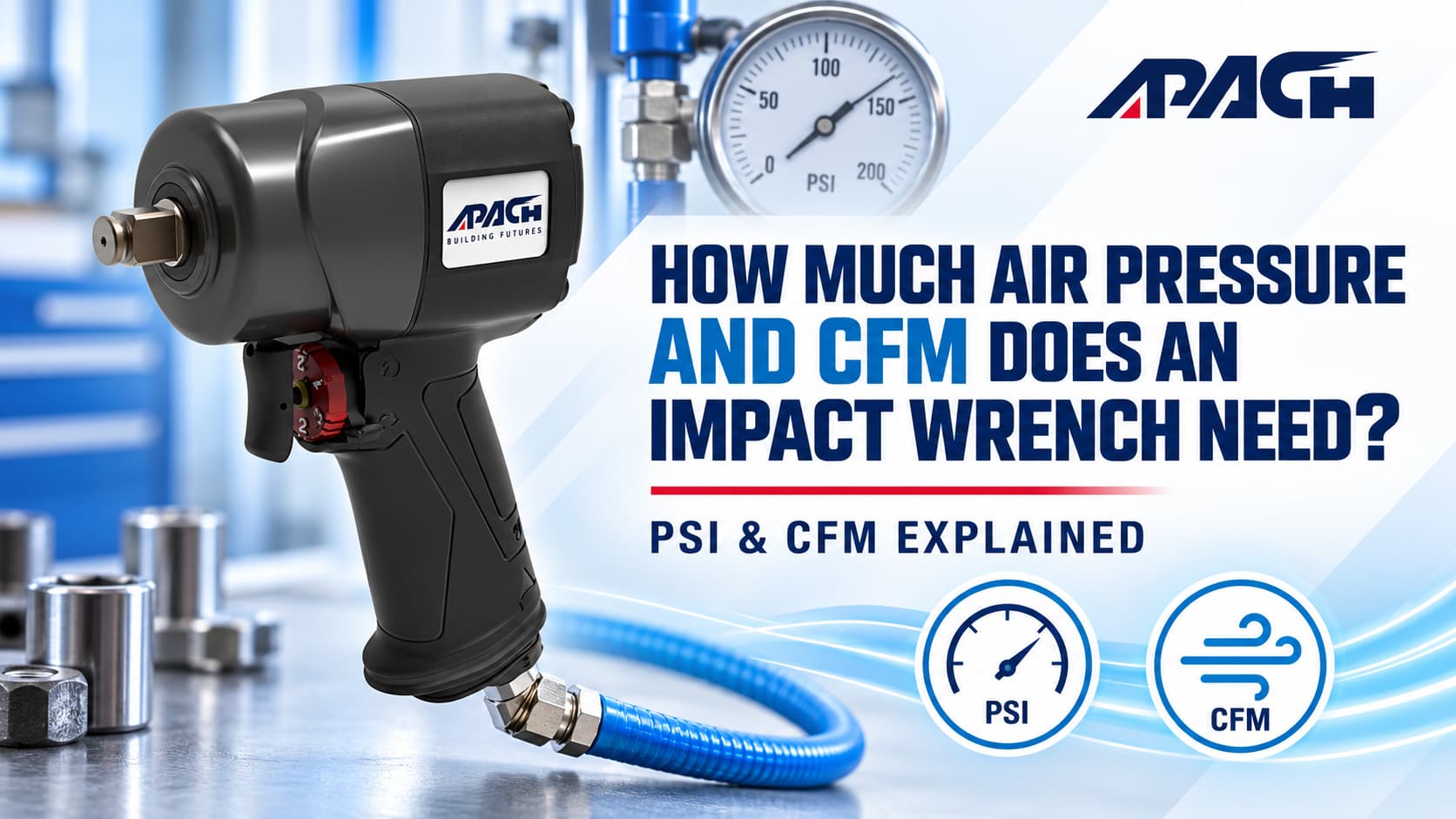
Most air impact wrenches are designed to operate at approximately 90 PSI (6.2 bar), but pressure alone does not determine performance. The air supply must also deliver enough CFM at the required working pressure.
For correct equipment selection, remember these four points:
- Follow the pressure and air-consumption specifications of the individual wrench.
- Check pressure while the tool is running, not only while it is idle.
- Size the compressor according to its delivered CFM at the required PSI.
- Make sure hoses, couplers, filters, and regulators do not restrict airflow.
A compressor may show 90 PSI while the impact wrench still lacks power. This usually means the required pressure or airflow is not reaching the tool during operation.
Table of Contents
- How Much PSI Does an Impact Wrench Need?
- PSI vs. CFM: What Is the Difference?
- Why Can an Impact Wrench Be Weak at 90 PSI?
- How Much CFM Does an Impact Wrench Need?
- How to Select the Right Air Compressor
- How Do Hose Size and Fittings Affect Performance?
- Can Higher PSI Produce More Torque?
- Air Supply Checklist
- Choosing the Right Air Impact Wrench
- FAQ
How Much PSI Does an Impact Wrench Need?
Approximately 90 PSI at the tool inlet is a common rated operating pressure for air impact wrenches. However, it is not a universal requirement. Always confirm the specification of the selected model before setting the regulator.
The pressure should be checked while the wrench is operating. A gauge reading taken while the tool is idle only shows static pressure. Once the trigger is pressed, the pressure may fall because of:
- Insufficient compressor output
- An undersized or excessively long hose
- Restrictive couplers or regulators
- Clogged filters
- Air leakage
- Other pneumatic tools using the same supply
If a regulator displays 90 PSI at rest but the pressure falls significantly during operation, the wrench may not produce its rated performance.
PSI vs. CFM: What Is the Difference?
PSI and CFM measure different parts of the air supply.
| Term | Meaning | Why It Matters |
|---|---|---|
| PSI | Pounds per square inch | Indicates the air pressure supplied to the tool |
| CFM | Cubic feet per minute | Indicates the volume of air delivered over time |
| SCFM | Standard cubic feet per minute | States airflow under defined reference conditions |
| Tank capacity | Volume of stored compressed air | Supports temporary demand but not continuous airflow |
In simple terms, PSI provides the operating pressure, while CFM keeps enough air flowing to sustain performance.
A system can have adequate pressure but insufficient airflow. In this situation, the wrench may start normally and then lose speed or impact force as the available air supply falls.
Why Can an Impact Wrench Be Weak at 90 PSI?
The most common reason is that the gauge is not showing the actual pressure at the tool while it is running.
Pressure is lost as compressed air moves through the system. Long hoses, narrow passages, small quick-connect fittings, and clogged air-treatment components all create resistance.
For an accurate check:
- Connect the wrench using its normal hose and fittings.
- Run the tool according to the manufacturer’s instructions.
- Measure pressure as close to the tool inlet as practical.
- Compare the operating pressure with the tool specification.
- Inspect the supply line if the pressure drops excessively.
Do not compensate for a restrictive air line by raising the regulator above the tool’s rated pressure. If sufficient pressure is shown but the tool still underperforms, read Why Is My Air Impact Wrench Losing Power? (Complete Fix Guide) to check lubrication, leakage, usage conditions, and internal wear.
How Much CFM Does an Impact Wrench Need?
There is no single CFM value that applies to every impact wrench. Required airflow varies according to:
- Tool model and motor design
- Drive size
- Impact mechanism
- Operating speed
- Torque capacity
- Trigger duration
- Application load
Drive size can indicate the general capacity of a tool, but it should not be used alone to calculate airflow. Two 1/2-inch impact wrenches may have very different air-consumption requirements.
The product specification may state average air consumption, air consumption at load, or both. These figures are not interchangeable.
Average air consumption may be based on intermittent operation. Air consumption at load more closely represents demand while the tool is running. For frequent fastening or production applications, relying only on an average figure may result in an undersized compressor.
How to Select the Right Air Compressor
When choosing a compressor for air pneumatic tools, check its delivered airflow at the pressure required by the tool. A compressor’s maximum PSI does not show how much air it can continuously supply.
1. Check the Tool Specification
Identify the specified operating pressure, air consumption, air inlet, and minimum hose size.
2. Compare Airflow Under the Same Conditions
Compare the wrench requirement with the compressor’s rated output at the relevant working pressure. Make sure both figures use compatible units and rating conditions.
3. Allow for System Losses
Filters, dryers, regulators, hoses, fittings, and leakage can reduce the usable airflow reaching the workstation. The compressor should not be selected with no reserve capacity.
4. Calculate Simultaneous Demand
If several pneumatic tools can operate at the same time, add their expected concurrent airflow requirements. There is no need to include tools that will not run simultaneously.
5. Consider Operating Frequency
A compressor may operate a wrench briefly by drawing stored air from its receiver tank. During repeated or continuous use, pressure will fall if the compressor cannot replenish air as quickly as the system consumes it.
A larger tank can extend short operating periods, but it does not increase the compressor pump’s continuous airflow capacity.
How Do Hose Size and Fittings Affect Performance?
The hose and fittings must be capable of carrying the required airflow. A small restriction anywhere in the line can reduce performance.
For a reliable installation:
- Use at least the minimum hose diameter specified for the tool.
- Increase the hose diameter when longer runs cause excessive pressure loss.
- Keep hoses as short and straight as practical.
- Avoid unnecessary reducers and adapters.
- Use couplers and fittings with adequate flow capacity.
- Keep filters and moisture separators clean.
- Inspect connections regularly for leaks.
Heavy-duty impact wrenches normally require greater airflow and may need larger hoses, fittings, and air inlets. Always follow the specifications of the individual model instead of assuming that one hose size suits every wrench.
Can Higher PSI Produce More Torque?
Increasing pressure above the manufacturer’s recommendation is not a safe solution for insufficient torque.
Excessive pressure may:
- Accelerate wear of the air motor and seals
- Damage the impact mechanism
- Increase vibration and noise
- Raise air consumption
- Shorten tool life
- Create inconsistent fastening results
An impact wrench is designed for rapid tightening and loosening, not precise final-torque control. Actual fastener torque is also affected by impact time, socket condition, joint friction, thread condition, and operator technique.
When a specified final torque is required, verify the fastener with an appropriate calibrated torque device or approved tightening procedure.
Air Supply Checklist
Before using an air impact wrench, confirm that:
- The regulator matches the tool’s specified pressure.
- Pressure remains adequate while the tool operates.
- The compressor supplies sufficient CFM at that pressure.
- The hose meets the minimum diameter requirement.
- Couplers and fittings provide adequate flow.
- Filters and regulators are clean and correctly sized.
- Connections do not have significant air leaks.
- Simultaneous tool demand has been considered.
- The tool is lubricated according to its instructions.
- The wrench has sufficient torque capacity for the application.
Air supply is only one part of reliable pneumatic-tool operation. Proper lubrication is also necessary to control friction and internal wear. For maintenance guidance, read Do Air Impact Wrenches Need Oil? Maintenance Guide for Longer Lifespan.
Choosing the Right Air Impact Wrench
APACH provides air impact wrenches in 3/8-inch, 1/2-inch, 3/4-inch, 1-inch, and 1-1/2-inch configurations. The range supports automotive service, machinery assembly, agricultural equipment, and industrial maintenance.
Before selecting a model, consider:
- Required working torque
- Fastener size and joint condition
- Operating frequency
- Available pressure and airflow
- Hose diameter and length
- Workspace limitations
- Expected duty cycle
Evaluating the tool and air system together helps prevent weak performance, excessive compressor cycling, and premature tool wear.
With experience in pneumatic-tool development and OEM/ODM cooperation, APACH can help buyers evaluate drive size, impact mechanism, torque capacity, and air-supply requirements for different operating conditions.
Need Help Matching the Tool to Your Air Supply?
For help selecting an impact wrench that matches your fastening application and compressed-air system, contact APACH with your required torque, operating frequency, available PSI, and airflow conditions.
Frequently Asked Questions
Is 90 PSI enough for every air impact wrench?
No. It is a common rated pressure, but the correct value depends on the model. Follow the manufacturer’s specification and verify pressure while the tool is running.
Why is my impact wrench weak even though the gauge shows 90 PSI?
The gauge may show static pressure. An undersized hose, restrictive fitting, leakage, or insufficient compressor output may cause pressure to drop when the wrench operates.
Should I use average CFM or air consumption at load?
For frequent or extended operation, air consumption at load provides a more conservative reference when it is available. Check how the manufacturer defines each rating before comparing it with compressor output.
Does a larger air tank increase CFM?
No. A larger tank stores more compressed air and can support temporary demand, but it does not increase the compressor pump’s continuous airflow output.
Can I increase the PSI when the wrench cannot loosen a bolt?
Do not exceed the tool’s rated pressure. First check dynamic pressure, airflow, hoses, fittings, lubrication, socket condition, and whether the wrench has enough capacity for the application.